
Date: Wednesday, 21 January 2026, 12:15 pm to 13:45 pm
Venue: Kollegienhaus KH 1.020
About: This event is organized by the RTG Dimensions of Constructional Space.
Title: Dependent-Marked Anticausatives in Old Norse-Icelandic: Modeling Productive and Unproductive Alterations
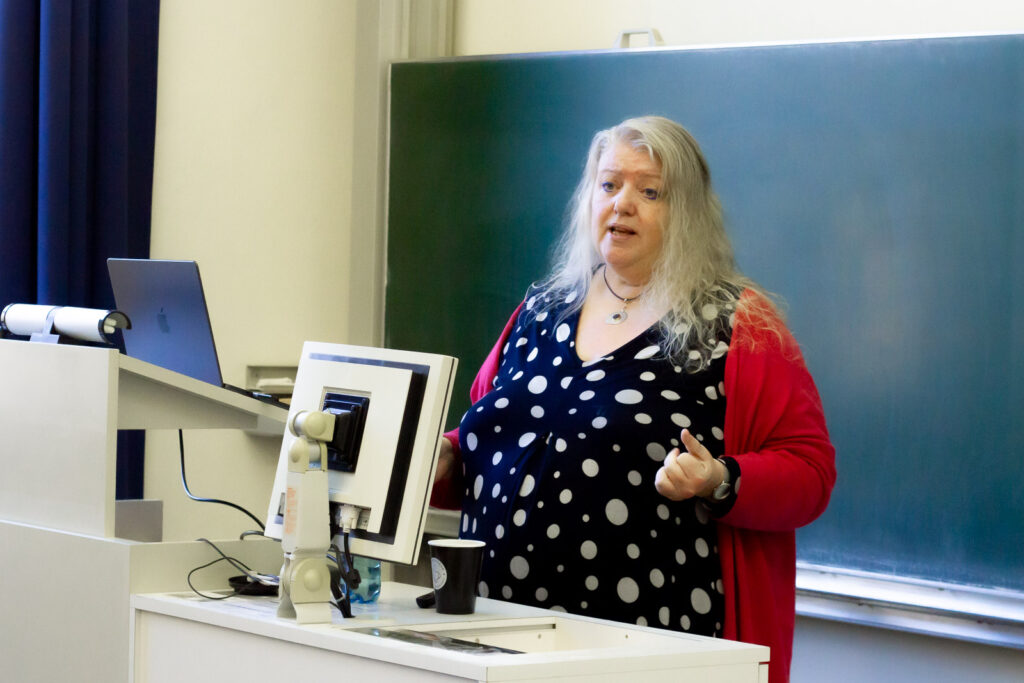
About the speaker: Jóhanna Barðdal (Ghent University) is a Professor of Scandinavian Linguistics at Ghent University. Her research focuses on argument structure, case marking, grammatical relations, verbal semantics, historical–comparative Germanic and Indo-European construction grammar, cognitive linguistics, as well as syntactic and semantic reconstruction.
Abstract
The process of anticausativization is well known in the functional and typological literature as involving a morphological affix on the head, i.e. the verb. In this article, we introduce to the field a different type of anticausatives which are dependent-marked and not head-marked. That is, the subject of the intransitive carries the same morphological case, namely accusative, as the object of the corresponding transitive, while the verb remains unmarked in both alternants. This research is based on 119 causative–anticausative pairs of this type in Old Norse-Icelandic, of which 80 are presented in the literature for the first time. Since the head, the verb, is morphologically unmarked, the question arises as to the directionality of the alternation. We argue that the causative alternant is the basic one, while the intransitive anticausative is ‘derived’, due to both morphological and semantic considerations, in particular the fact that many accusative anticausatives have developed metaphorical meanings. We couch our analysis in the formalism of CxG, showing how changes in the productivity of the alternation may be modeled. While the data discussed here are mostly confined to Old Norse-Icelandic, the distinction between head-marking and dependent-marking anticausativization is clearly of relevance for general linguists, functionalists and typologists alike.