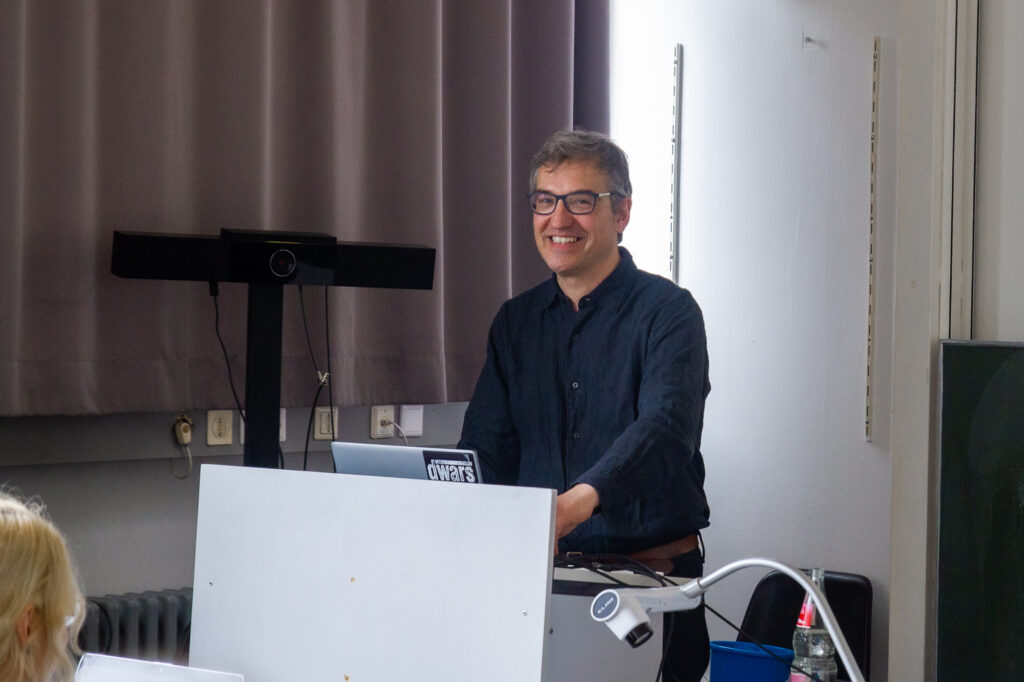
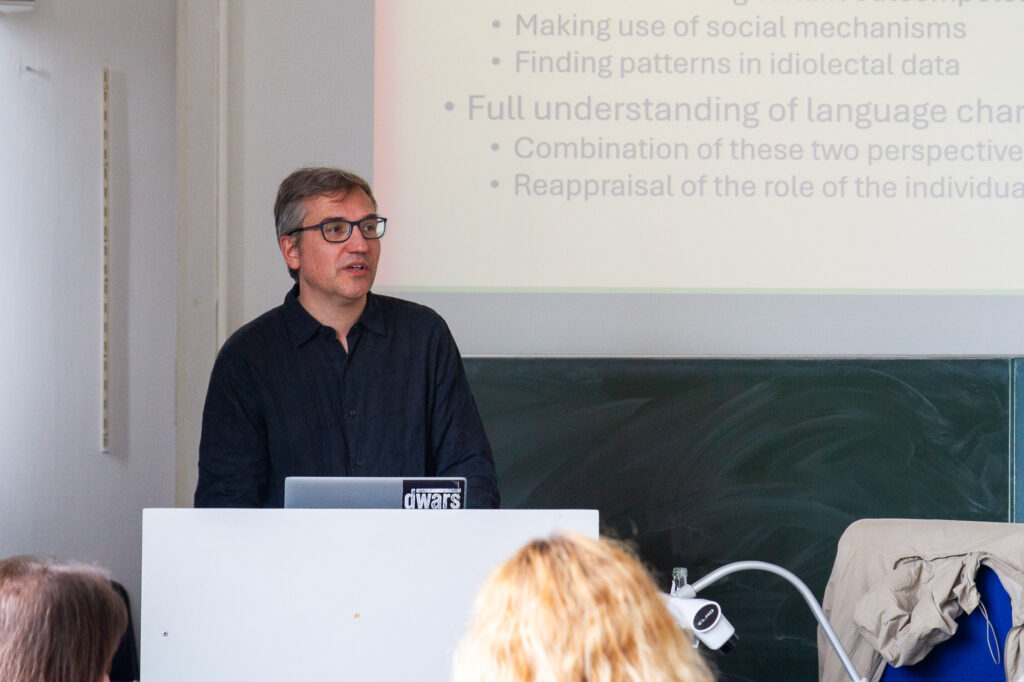
A guest lecture by Prof. Dr. Peter Petré was held at the building of the Philosophical Faculty at FAU Erlangen Nuremberg for the members of the RTG and the Faculty.
On 20th of May our RTG had the honour of hosting at FAU Erlangen-Nuremberg Dr. Peter Petré, professor of English and General Linguistics at the University of Antwerp. After a dinner with some of the members of our RTG and a coffee meeting away from the formalities of the lecture halls, at our offices in Schillerstraße, where the distinguished guest had the opportunity to interact with our researchers and provide his views on their projects, he talked in front of the RTG assembly about his latest work on individuality and language change.
The RTG is very interested in Prof. Petré’s work seeing that his contribution to a variety of fields has been significant. Among others, he has worked in the fields of Historical Linguistics and Diachronic Construction Grammar but also Cognitive Linguistics, Historical Sociolinguistics, Historical Pragmatics and Digital Humanities. His additions to Complex Adaptive Systems, Individual Cognition and the interaction between local and global change have progressed the fields and attracted the interest from a plethora of researchers within our group, working on diachronic and synchronic projects. As Prof. Lotte Sommerer stated during her introduction “he [Petré] embodies the quantitative turn in historical linguistics” and “combines the best of both worlds”, being a cognitive functional philologist with impressive knowledge in the nuances of all stages of historical English and a top-notch quantitative researcher able to use sophisticated methods to handle Big Data.
In his talk he set two fundamental questions : “Where are the individuals in Historical Linguistics and do we need them anyway?” and “Is it only language that changes, or do language users also change?” and proceeded to examine them via the grammaticalization of the [BE Ving] construction using the famous EMMA corpus, advanced statistical methods and what was called ‘aptness for traditional grammar training,’ a new notion that introduces the subject of neurodiversity in the field of Language Change.
Concluding this, we would like to thank again Prof. Petré for all the interesting discussions we have had during his stay and we are looking forward to further collaborations with him and his team.
“If it were not for the great variability among individuals, medicine might as well be a science and not an art”. – Sir William Osler, 1892.
Text: Theocharis Tzimas.